First principles, not fitted. PCBE encodes mechanistic rules from real equations: Reynolds number for mixing, Henderson-Hasselbalch for ionisation, DLVO for colloidal stability, proton-sponge behaviour for endosomal escape. Every prediction traces back to the physics behind it.
Formulations,
engineered from
first principles.
GyaniMed predicts how a formulation will behave before it is ever made. One causal engine, grounded in real physics, working across LNP and mRNA, biologics, antibody-drug conjugates, and cell therapies.
- Ionisable lipid
(SM-102 analog)46.5mol% - Cholesterol42.0mol%
- DSPC10.0mol%
- DMG-PEG-20001.5mol%
- Z-average diameter···
- Polydispersity (PDI)···
- Encapsulation···
Four models.
One causal engine.
The QbD Causal AI Engine is built from scratch, with no off-the-shelf libraries. Four models work together to turn formulation chemistry into a prediction you can defend.
PEM places more than fifty formulation parameters into a shared 32-dimensional space, so the engine reasons about similarity across lipids, process, and quality together, rather than treating each one in isolation.
A compact Bayesian network learns the nonlinear interactions the rules do not capture, and reports confidence with every prediction. You see the expected size or encapsulation, and how sure the model is.
GEM turns the engine's reasoning into plain language, drawing on the causal relationships between materials, process, and quality. Every result arrives with the mechanism behind it, not just a number on a chart.
The platform scientists actually use.
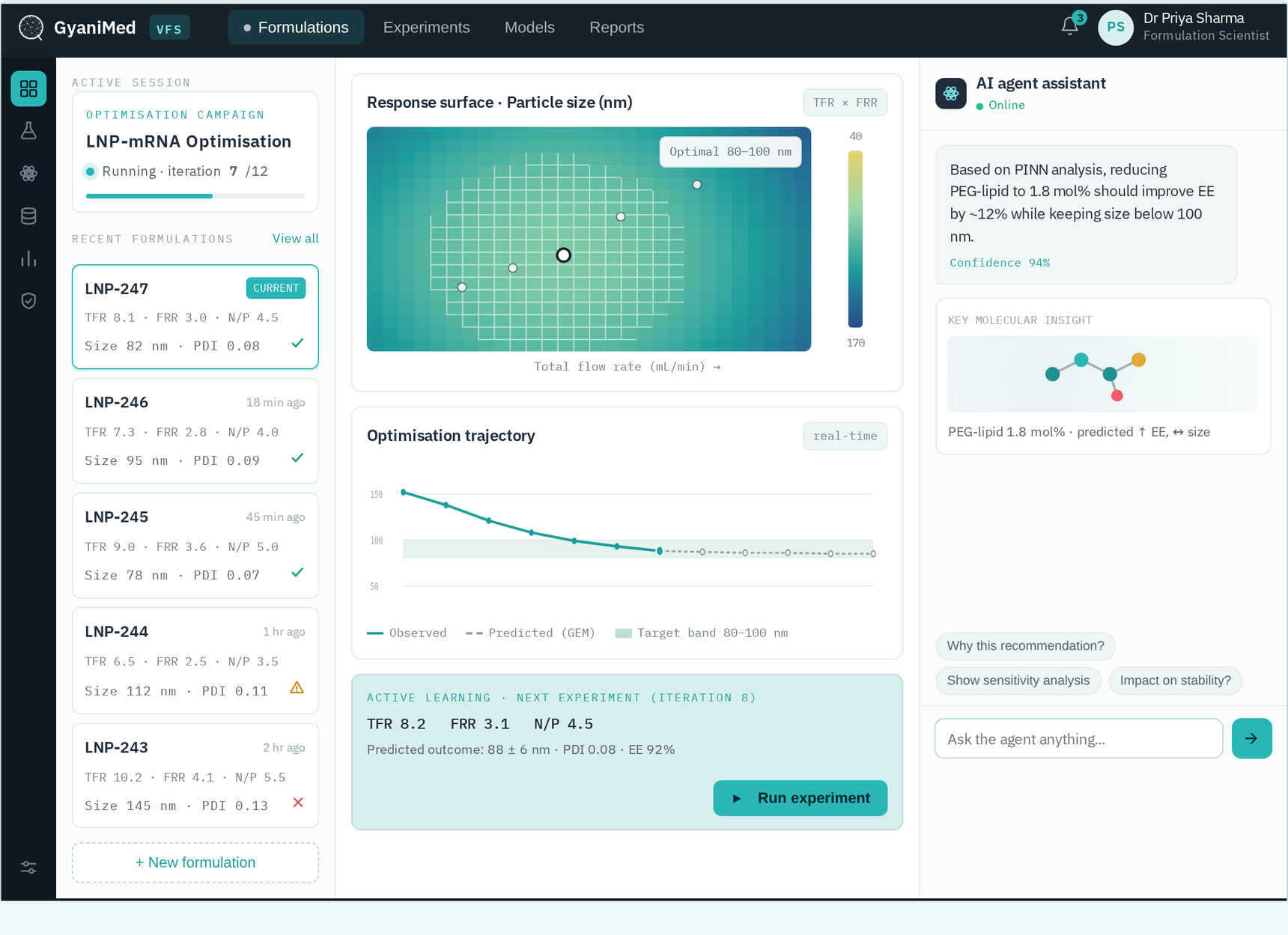
A natural-language workspace with 3D response surfaces, active-learning suggestions, an AI agent, and GxP compliance, in one environment. This preview is a live, interactive screen.
Designed,
not screened.
The old way is screen, measure, repeat. We predict first, then make.
A formulation's quality attributes, its size, polydispersity, encapsulation, and potency, sit on a surface shaped by material attributes and process parameters. Most AI treats that surface as a black box. GyaniMed treats it as physics.
We model the chemistry and transport that actually govern the outcome. That makes a prediction something you can reason about before it is made, and refine without going back to the start.
We can rationalise a formulation before we make it, and improve it without returning to the bench.
LNP and mRNA
Lipid composition, mixing, and encapsulation, predicted as a system.
Biologics
Stability and aggregation handled through the underlying physics.
ADCs
Conjugation and load balanced against quality from the outset.
Cell therapies
Process-sensitive products mapped to defensible design spaces.
Every delivery system,
in three dimensions.
GyaniMed reasons about each carrier and formulation as a physical object, not a label. Explore the delivery and formulation systems the engine works across — from lipid nanoparticles and emulsions to biologics, conjugates, and engineered cells — each with the quality attributes that matter.
Auditable by design.
Mechanistic predictions are not only more accurate, they are defensible. GyaniMed is built to the frameworks pharmaceutical development already runs on.
Building something that needs formulation? Let's talk.
We work with teams developing LNP and mRNA, biologics, ADCs, and cell therapies. We are also raising our seed round.